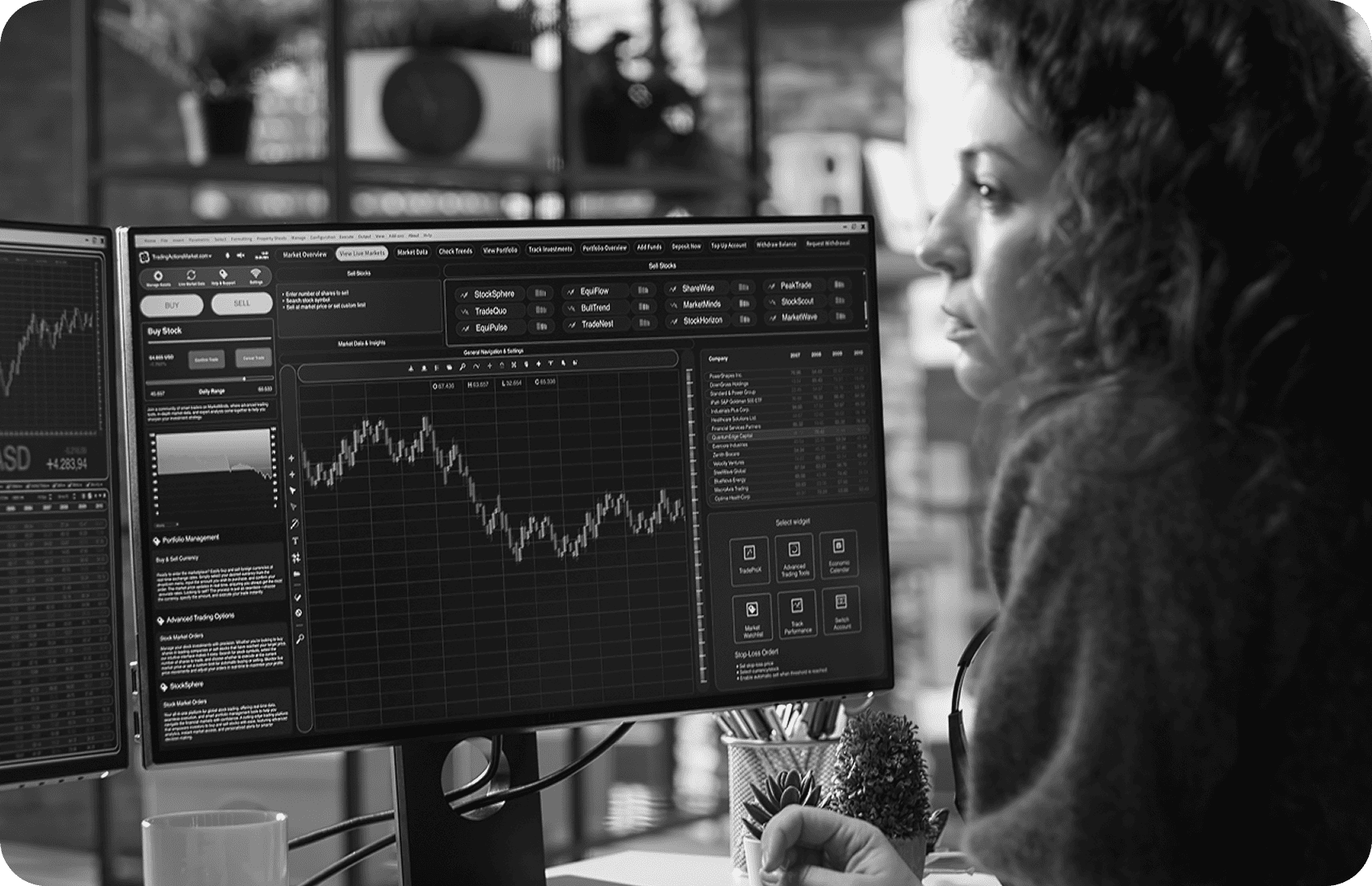
Algorithmic trading refers to using predefined rules and logic to make trading decisions and execute trades automatically or semi-automatically.
A trading algorithm does not predict the future. It executes a repeatable process under specific conditions.
Instead of reacting emotionally or manually to the market, algorithmic trading relies on:
Algorithms exist to remove or reduce these limitations.
They are designed to:
Algorithmic trading is about process control, not intelligence.
Every trading algorithm, regardless of complexity, is built from the same core elements.
Algorithms consume data such as:
Without reliable data, algorithms fail.
This defines when and why a trade should occur.
Logic is rule-based, not discretionary.
Execution logic defines how trades are placed.
Execution quality often determines whether a strategy remains profitable.
Risk rules are embedded directly into the algorithm.
Without automated limits, algorithms can fail catastrophically.
These follow clearly defined conditions such as:
They are simple, transparent, and easier to test.
Designed to:
Perform well in trending markets and poorly in ranges.
Based on the idea that price tends to return to an average.
They perform well in range-bound markets and poorly during strong trends.
These do not decide what to trade, but how to trade. They aim to:
Used heavily by institutions.
Backtesting evaluates how a strategy would have performed using historical data.
Backtesting helps identify:
However, backtests are not guarantees of future performance.
One of the biggest risks in algorithmic trading is overfitting.
Overfitting occurs when:
Markets evolve. Strategies that worked in one regime may fail in another. This leads to strategy decay — the gradual loss of effectiveness over time.
| Aspect | Human Trader | Algorithm |
|---|---|---|
| Emotion | High | None |
| Speed | Limited | High |
| Consistency | Variable | High |
| Adaptability | Strong | Limited |
| Discipline | Difficult | Built-in |
Algorithms execute well. Humans adapt well. Advanced trading combines both.
Algorithmic trading has clear limitations:
Algorithms do not remove risk — they formalize it.